03 - Coordinate Systems and Scene Geometry
Before starting a simulation, it is critical to understand LESS's coordinate system and angle conventions. This chapter introduces these basic concepts.
Coordinate system
LESS uses a right-handed coordinate system with the origin at the northwest corner of the scene ground:
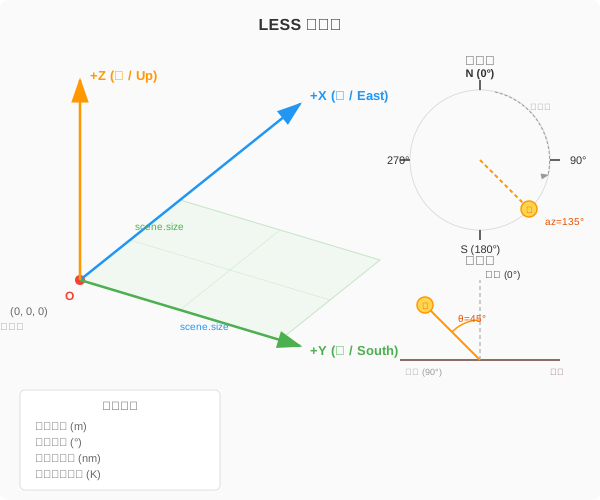
| axis | direction | unit |
|---|---|---|
| X | East (East) | Meters |
| Y | South (South) | Meters |
| Z | Up (Up) | Meters |
The origin
(0, 0, 0)is located at the northwest corner (upper left corner) of the scene ground, z = 0 is the ground.
Scene size
scene.size defines the coverage of the scene ground:
import less

scene = less.Scene()

# Square scene: 50m × 50m
scene.size = 50.0

# Rectangular scene: 100m (east-west) × 50m (north-south)
scene.size = (100, 50)
The scene ground extends from (0, 0) to (size_x, size_y) on the XY plane.
Object placement
The position coordinates of the object (x, y, z) follow the same coordinate system:
# Place a tree in the center of the scene (z=0 represents the ground)
positions = [[25.0, 25.0, 0.0]]
scene.add(tree, positions=positions)

# Place in the southeast corner
positions = [[45.0, 45.0, 0.0]]
scene.add(tree, positions=positions)
Angle agreement
Zenith Angle
Zenith angle is measured from directly above (zenith):
| Zenith Angle | Meaning |
|---|---|
| 0° | Directly above (zenith/nadir point) |
| 30° | Sun altitude angle 60° |
| 60° | Sun altitude angle 30° |
| 90° | Horizontal |
# The sun is directly above
scene.illumination = less.Illumination(source=less.Sun(zenith=0, azimuth=180.0), atmosphere=less.NoAtmosphere())

# Sun altitude angle is about 60° (morning or afternoon)
scene.illumination = less.Illumination(source=less.Sun(zenith=30, azimuth=180.0), atmosphere=less.NoAtmosphere())
Azimuth Angle
Azimuth starts from due north and goes clockwise Measure:
| Azimuth | Direction |
|---|---|
| 0° | North (-Y) |
| 90° | East (+X) |
| 180° | South (+Y) |
| 270° | West (-X) |
# The sun is in the southeast
scene.illumination = less.Illumination(source=less.Sun(zenith=30, azimuth=135), atmosphere=less.NoAtmosphere())

# The sensor looks from the west
sensor = less.Orthographic(
    view_zenith=30,
    view_azimuth=270,  # West
)
This is consistent with standard convention in the field of remote sensing.
Calculate sun position
LESS provides tools to calculate solar zenith angle/azimuth angle based on longitude, latitude and time:
from datetime import datetime
import less

# Beijing, June 21, 2024 10:00 (UTC+8)
sun = less.compute_sun_position(
    latitude=39.9,
    longitude=116.4,
    date_time=datetime(2024, 6, 21, 10, 0),
)
print(f"solar zenith angle: {sun.sun_zenith:.1f}°")
print(f"Sun azimuth angle: {sun.sun_azimuth:.1f}°")
Unit summary
| Physical quantity | Unit |
|---|---|
| Location, distance | Meters (m) |
| Angle (zenith angle, azimuth angle) | Degrees (°) |
| Reflectance/Transmittance | Dimensionless [0, 1] |
| Wavelength | Nanometer (nm) |
| Temperature | Kelvin (K) |
| Irradiance | W/m²/nm |
| Radiance | W/m²/sr/nm |
Next step
Related API
less.Scene、less.Object、less.Scene.add()less.Illumination、less.Sun、less.NoAtmosphere、less.Orthographicless.compute_sun_position()