A8 - Energy balance, photosynthesis and leaf temperature
Leaves under the same illumination can reach different temperatures as air temperature, humidity, wind and transpiration change. This case places a leaf in an open-top cavity, starting with radiation equilibrium and fixed stomatal resistance, then testing photosynthesis, dynamic stomata and leaf-temperature coupling. Four parts share the same geometry and compare against closed-form solutions or independently solved equations.
Scene and inputs
Drag to rotate, or open the scene separately. Walls and ground have prescribed temperatures; the leaf temperature is solved. The hot-wall condition heats only the east wall to 340 K.
| Setting | Value |
|---|---|
| Cavity | 4 m × 4 m, height 3 m, open top and open lateral boundaries |
| Walls and ground | Shortwave reflectance 0, longwave emissivity 1, prescribed environmental temperature |
| Leaf | 1 m × 1 m, centered at (2, 2, 1) m, two triangles with separately solved temperatures |
| Optical properties | Reflectance 0.2, transmittance 0; opaque in the thermal infrared |
| Sun | 550 nm, bandwidth 1 nm; E below is normal spectral irradiance in W m⁻² nm⁻¹ |
| Sky | No atmosphere or shortwave skylight; downwelling longwave σTₑ⁴ |
| Initial leaf temperature | 280 K; additional starts at 260 K and 330 K |
| Longwave samples | Per triangle per side: 32, 128, 512; hot wall: 512, 2048, 8192, 32768 |
Each row below is run on all three backends. The leaf is horizontal and the sun is at zenith, except in condition 4: the leaf rises 30° toward the east, and the sun is eastward at zenith angle 30°, giving an incidence cosine of cos 60°.
| No. | Condition | E | Environment / K | Emissivity | Radiating sides | Stomata | Additional settings |
|---|---|---|---|---|---|---|---|
| 1 | Isothermal equilibrium | 0 | 300 | 0.95 | 2 | Closed | — |
| 2 | Cool, weak illumination | 100 | 280 | 0.95 | 2 | Closed | — |
| 3 | Low emissivity, strong illumination | 400 | 285 | 0.70 | 2 | Closed | — |
| 4 | Tilted leaf | 400 | 300 | 0.95 | 2 | Closed | Incidence 60° |
| 5 | One-sided exchange | 200 | 295 | 0.90 | 1 | Closed | — |
| 6 | Sensible heat | 400 | 300 | 0.95 | 2 | Closed | Air 25°C, RH 50% |
| 7 | Lower-surface transpiration | 400 | 300 | 0.95 | 2 | Bottom | Air 25°C, RH 50% |
| 8 | Humid air | 400 | 300 | 0.95 | 2 | Bottom | RH 90% |
| 9 | Two-sided transpiration | 400 | 300 | 0.95 | 2 | Both | RH 50% |
| 10 | Wind-driven exchange | 400 | 300 | 0.95 | 2 | Bottom | Wind 4 m/s, leaf width 0.05 m; resistance from width and wind |
| 11 | Hot wall | 400 | 300 | 0.95 | 2 | Bottom | East wall 340 K |
In conditions 1–5, air temperature equals the analytic radiation-equilibrium temperature, so sensible heat vanishes at the solution. Conditions 6–11 use air temperature 25°C and RH 50%, except condition 8 at 90%. Prescribed aerodynamic resistance is 100 s/m and stomatal resistance is 150 s/m; condition 10 computes aerodynamic resistance from leaf width and wind. Leaf ground heat flux G is zero.
Independent references
Step 1: Radiation-equilibrium point
For reflectance r, emissivity ε, n radiating sides and environmental temperature Tₑ, absorbed shortwave and longwave are
With transpiration closed and air temperature prescribed at the radiation-equilibrium point, H = LE = G = 0 at the solution:
Temperature, absorbed shortwave, absorbed longwave, emitted longwave and sensible heat are compared separately. Condition 1 also checks recovery of 300 K isothermal equilibrium without sunlight.
Step 2: Sensible heat and transpiration
With fixed stomatal resistance, independently solve
Temperatures are in K and vapor pressures in Pa. For prescribed aerodynamic resistance rₐ, C_H = ρcₚ/rₐ: this resistance describes whole-surface sensible heat exchange. When calculated from leaf width, rₐ = 200√(d/max(u, 0.1)) and C_H = nρcₚ/rₐ. The latent coefficient is C_E = nₛρcₚ/[γ(rₐ+rₛ)], where nₛ counts stomatal sides.
Constants are σ = 5.670374419 × 10⁻⁸ W m⁻² K⁻⁴, ρ = 1.225 kg/m³, cₚ = 1004 J kg⁻¹ K⁻¹ and γ = 66.5 Pa/K. The reference uses high-precision decimal arithmetic and bisection, without calling the LESS energy-balance solver. The first two parts use fixed stomatal resistance; the following two test photosynthesis-driven stomatal responses.
Hot wall and three-dimensional longwave exchange
Condition 11 uses triangle-averaged view factors:
The point-to-wall factor is evaluated from the polygon's projected solid angle, then integrated over each leaf triangle with Gauss quadrature. Two-sided east-wall factors are 0.180504129346 and 0.135629828566, giving slightly different temperatures for the two triangles. Increasing quadrature order from 32 to 64 changes factors by less than 10⁻¹². See Sandia's view-factor description for the defining integral.
Results
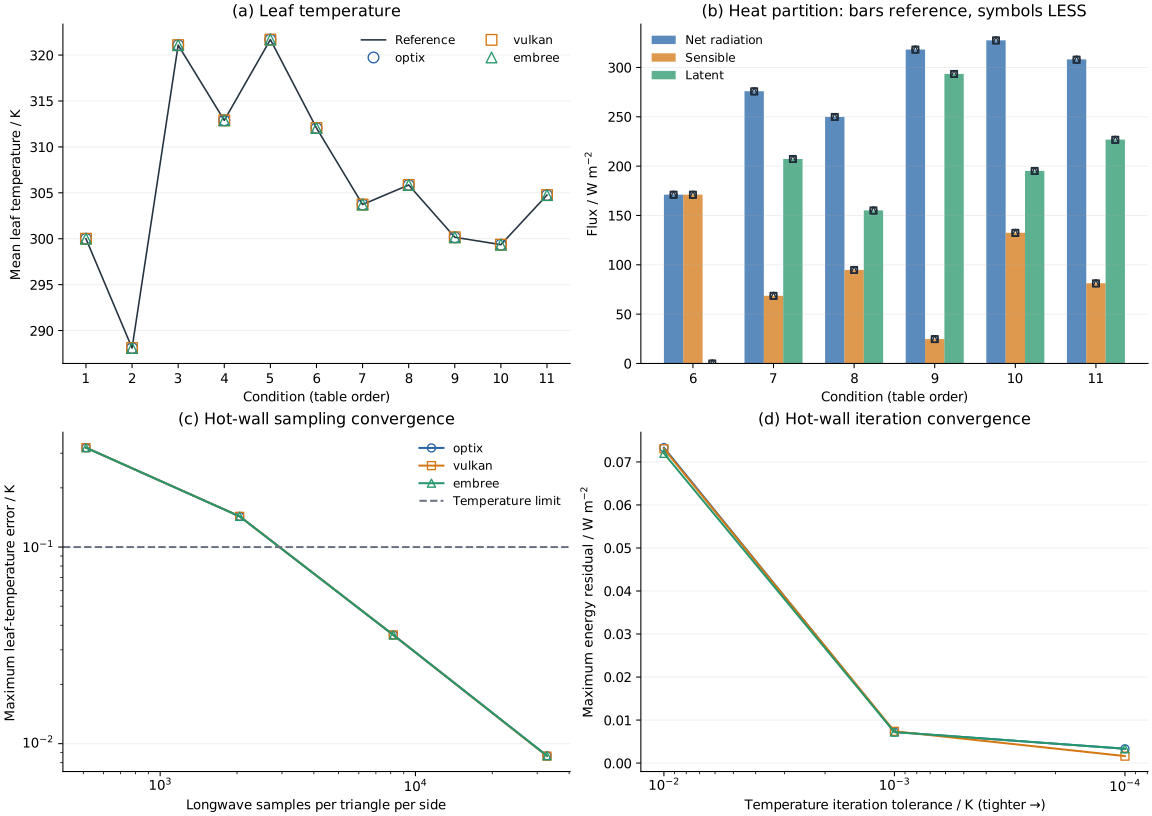
| Backend | Uniform-environment temperature error / K | Hot-wall temperature error / K | Energy closure / W m⁻² | Result |
|---|---|---|---|---|
| optix | 0.000221 | 0.008672 | 0.003326 | Pass |
| vulkan | 0.000221 | 0.008641 | 0.002930 | Pass |
| embree | 0.000221 | 0.008672 | 0.003342 | Pass |
All 33 final comparisons pass. Errors are maxima across the relevant conditions and both leaf triangles for each backend. Closure is independently evaluated as |S_abs + L_abs − L_emit − H − LE − G|. Fluxes use one-sided leaf area throughout.
Uniform-environment limits are 0.005 K for leaf temperature, 0.005 W/m² for absorbed shortwave, 0.02 W/m² for absorbed longwave and 0.05 W/m² for other fluxes. Hot-wall limits are 0.1 K for temperature and 3 W/m² for longwave and other fluxes. Every condition must close within 0.02 W/m².
Sampling and iteration convergence
The uniform environment provides an almost noise-free control; the hot wall tests longwave sampling. The figure increases sample counts with a fixed seed. The final temperature change from the preceding budget is below 0.05 K. Repeating the final budget with three seeds gives a maximum temperature standard deviation of 0.00832 K; backend means and fluctuations agree.
The low-emissivity strong-illumination and hot-wall conditions also tighten temperature/energy tolerances from 0.01 K / 0.5 W/m² through 0.001 K / 0.05 W/m² to 0.0001 K / 0.01 W/m². Between the final two levels, temperature changes by at most 0.000214 K and mean flux by 0.002708 W/m². Starting at 260 K or 330 K changes the final temperature by less than 0.005 K.
Photosynthesis and dynamic stomata
Step 3: Fixed leaf temperature
The opaque plane retains reflectance 0.2, using total absorbed photons to drive C₃ photosynthesis. With leaf temperature fixed, illumination, CO₂, humidity and temperature are varied separately. Absorbed PAR is Qλ/(hcNₐ) × 10⁶, in μmol photons m⁻² s⁻¹.
| Condition | E / W m⁻² nm⁻¹ | Leaf temperature / K | CO₂ / μmol mol⁻¹ | Ambient RH | Formulation |
|---|---|---|---|---|---|
| Dark | 0 | 298.15 | 400 | 50% | Default smooth co-limitation and explicit Jmax |
| Weak light | 25 | 298.15 | 400 | 50% | Default smooth co-limitation |
| Moderate light | 100 | 298.15 | 400 | 50% | Default smooth co-limitation and explicit Jmax |
| Strong light | 400 | 298.15 | 400 | 50% | Default smooth co-limitation and explicit Jmax |
| High CO₂ | 400 | 298.15 | 800 | 50% | Default smooth co-limitation |
| Dry air | 400 | 298.15 | 400 | 30% | Default smooth co-limitation |
| Warm leaf | 400 | 308.15 | 400 | 50% | Default smooth co-limitation |
Air temperature is 25°C. Vcmax25 = 60 μmol m⁻² s⁻¹, Rd25 = 0.9 μmol m⁻² s⁻¹, Ball–Berry slope m = 9 and intercept b = 0.01 mol H₂O m⁻² s⁻¹. The explicit-Jmax form uses Jmax25 = 120 μmol m⁻² s⁻¹. Pressure is 101325 Pa and oxygen 209 mmol mol⁻¹. The default smooth form is selected with formulation="scope"; the other form uses formulation="jmax".
The reference independently solves biochemical assimilation and stomatal diffusion from the Farquhar C₃ model, with the selected temperature responses:
The default form smoothly combines carboxylation, light and product-export limitations to obtain net assimilation Aₙ, using leaf-surface relative humidity hₛ. See the biochemical model description. The explicit-Jmax form computes electron transport from a nonrectangular hyperbola and takes the smaller carboxylation/electron-transport rate before subtracting respiration. It uses ambient humidity in the stomatal relation and the nonnegative part of Aₙ in diffusion. In darkness, assimilation equals negative dark respiration and conductance returns to b.
The reference bisects directly in intercellular CO₂ concentration, independently of the native LESS iteration. The reference and simulation script specifies all rates, temperature coefficients and both formulations.
Step 4: Coupled leaf temperature
Strong illumination is tested with baseline conditions, RH 90%, CO₂ 800 μmol mol⁻¹, an east wall at 340 K and the explicit-Jmax form. Starting at 280 K, stomatal conductance is calculated from photosynthesis and converted to water-vapor resistance:
Aerodynamic resistance remains 100 s/m, with stomata on the lower leaf surface. This coupled formulation uses cₚ = 1005 J kg⁻¹ K⁻¹ and γ = 66 Pa/K. At each candidate temperature, the reference first solves assimilation and conductance, then bisects the energy balance. The hot-wall reference uses the same independent triangle view factors.
Temperature, assimilation, conductance and flux errors are checked separately. LESS assimilation and conductance are substituted back into the biochemical and stomatal equations to check carbon closure. Sensible heat, latent heat and the energy residual are also independently recalculated from the returned temperature and conductance.
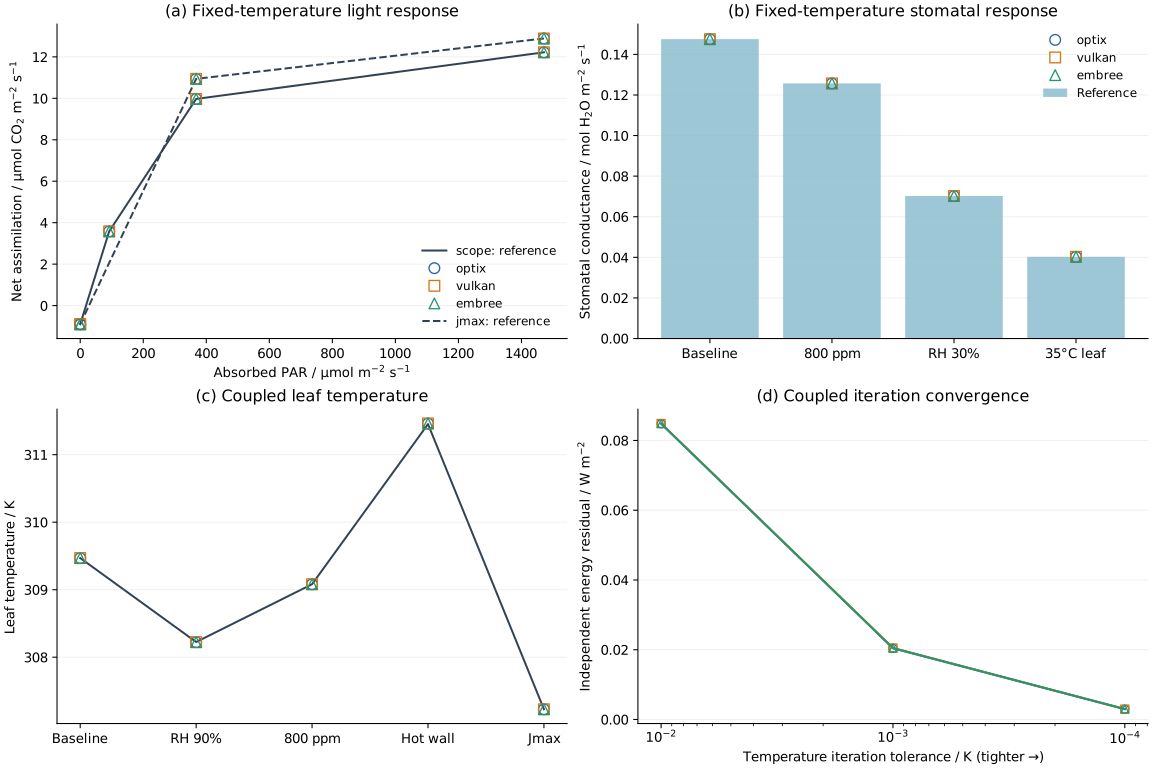
| Backend | Assimilation error / μmol m⁻² s⁻¹ | Conductance error / mol m⁻² s⁻¹ | Temperature error / K | Independent energy residual / W m⁻² | Result |
|---|---|---|---|---|---|
| optix | 0.004230 | 0.00007750 | 0.009891 | 0.003833 | Pass |
| vulkan | 0.004228 | 0.00007752 | 0.009891 | 0.003867 | Pass |
| embree | 0.004232 | 0.00007624 | 0.009891 | 0.003005 | Pass |
All 45 final comparisons pass across 15 added conditions and three backends. Limits are 0.02 μmol CO₂ m⁻² s⁻¹ for assimilation, 0.0005 mol H₂O m⁻² s⁻¹ for conductance and 0.002 μmol photons m⁻² s⁻¹ for APAR. Temperature limits are 0.005 K in uniform surroundings and 0.1 K with the hot wall; corresponding flux limits are 0.1 and 3 W/m². Returned fluxes must close within 0.02 W/m²; energy independently recalculated from temperature and conductance must close within 0.05 W/m².
Coupled conditions use 32, 128 and 512 longwave samples per triangle per side. Hot-wall budgets are 512, 2048, 8192, 32768 and 65536, with final temperature changes below 0.05 K. The default, hot-wall and explicit-Jmax conditions also tighten temperature, energy and physiological tolerances, ending at 0.0001 K, 0.01 W/m² and relative physiological change 0.0001. Tightening tolerances and starting from 260 K or 330 K changes final temperature by at most 0.000793 K, assimilation by 0.000668 μmol m⁻² s⁻¹ and conductance by 0.00000751 mol m⁻² s⁻¹.
Reproduce
Download the inputs, walls, horizontal leaf, tilted leaf, main script and physiology reference and simulation script. Preserve the relative scripts/ and data/energy-balance/ directories. With LESS, NumPy and Matplotlib installed, run all four parts:
The accuracy and convergence results contain current inputs, independent references, final fluxes and temperatures, and sampling and iteration checks.