Gallery
A maize field in visible and near-infrared light
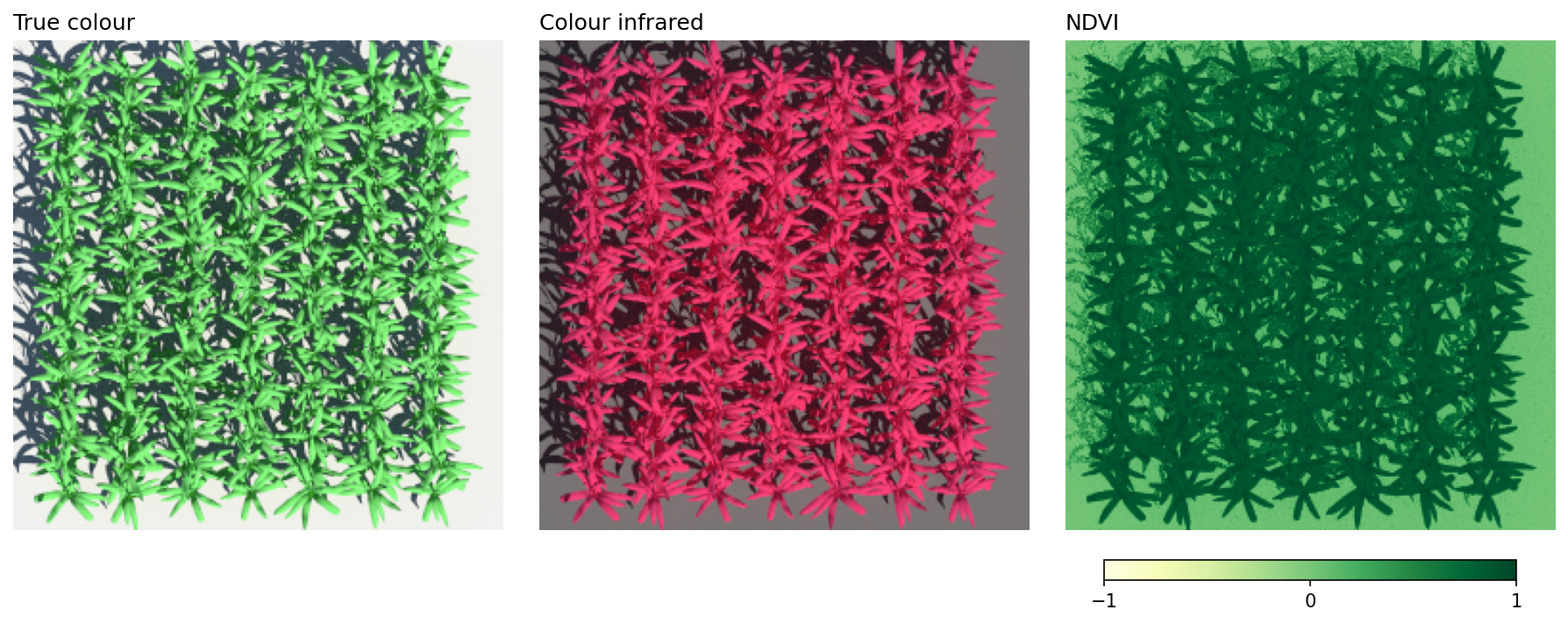
Follow a green leaf from the left image into the middle one. It appears red because the infrared composite maps reflectance at 850 nm to the red channel. The right image combines near-infrared and red reflectance factors into NDVI, with darker green indicating higher values. The exposed soil between rows has nearly zero NDVI because its prescribed reflectance is constant across wavelengths.
Download the maize example (ZIP)
Extract the script, maize mesh and instructions, then run python run.py to generate the figure. Try changing the row spacing in spacing to see how the exposed soil changes the NDVI pattern.
The sensor looks straight down on an 8 m × 8 m plot with a solar zenith angle of 35°. All three panels use the same four-band simulation. Each colour composite has its own brightness stretch. Explore other bands in Multispectral and hyperspectral imaging.
Forest LiDAR from above and below
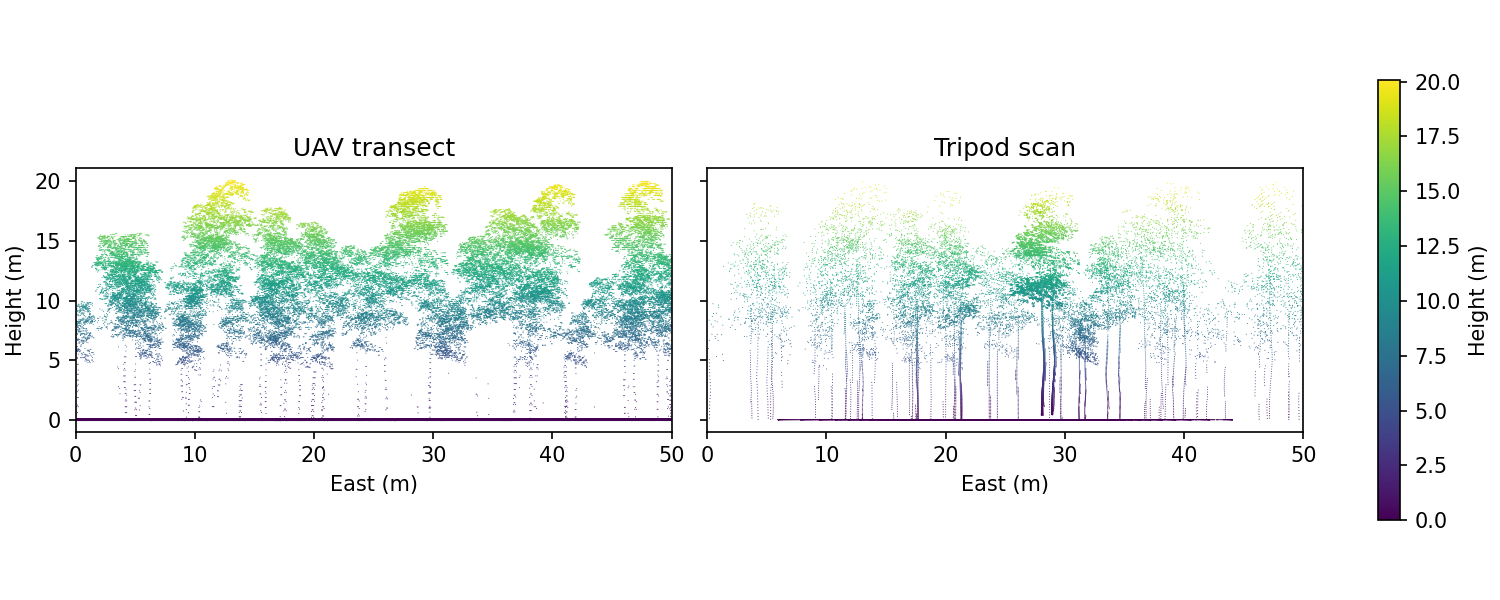
Two east–height projections show returns from the same forest. A UAV scans along a flight line and a tripod scans from one position inside the stand. Both panels use the same bounds and height scale. Compare coverage at the treetops and along the trunks.
Download the forest LiDAR example (ZIP)
Tree shadows in thermal infrared
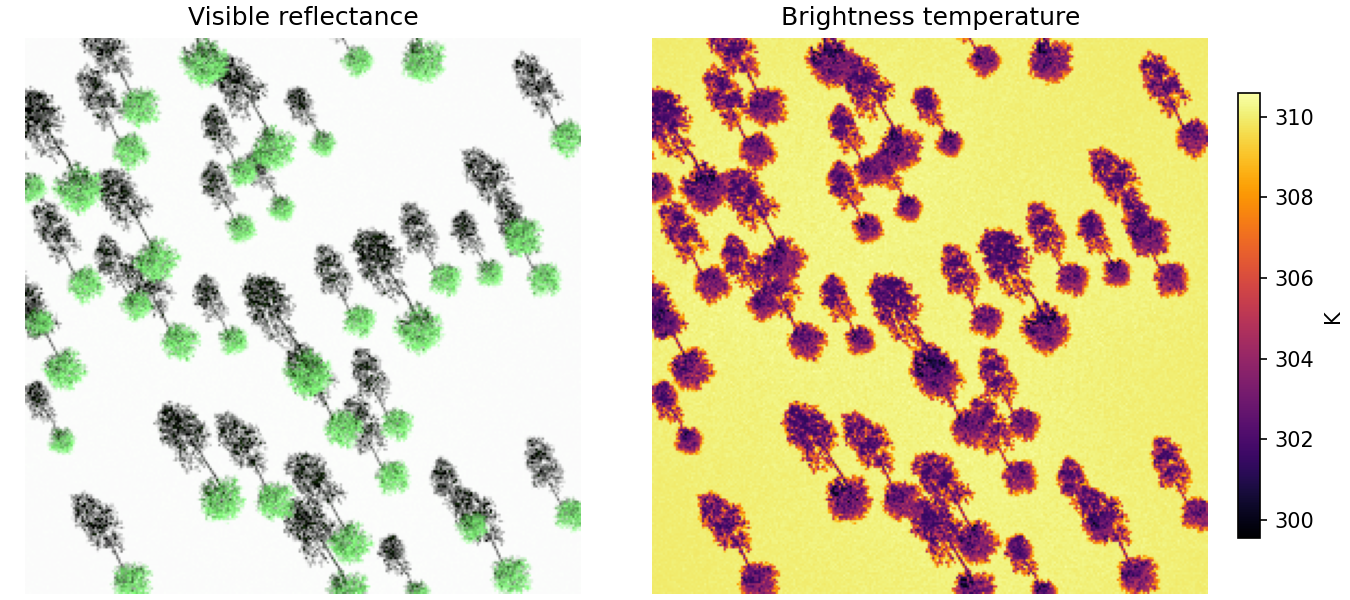
Visible reflectance and 10.6 µm brightness temperature share the same overhead view. Sunlit and shaded ground temperatures are prescribed at 312 and 303 K, respectively, and leaf temperatures at 305 and 300 K. Follow the shadows beyond the crowns into the thermal image.
Download the forest thermal imaging example (ZIP)
Watching sun glint enter the field of view
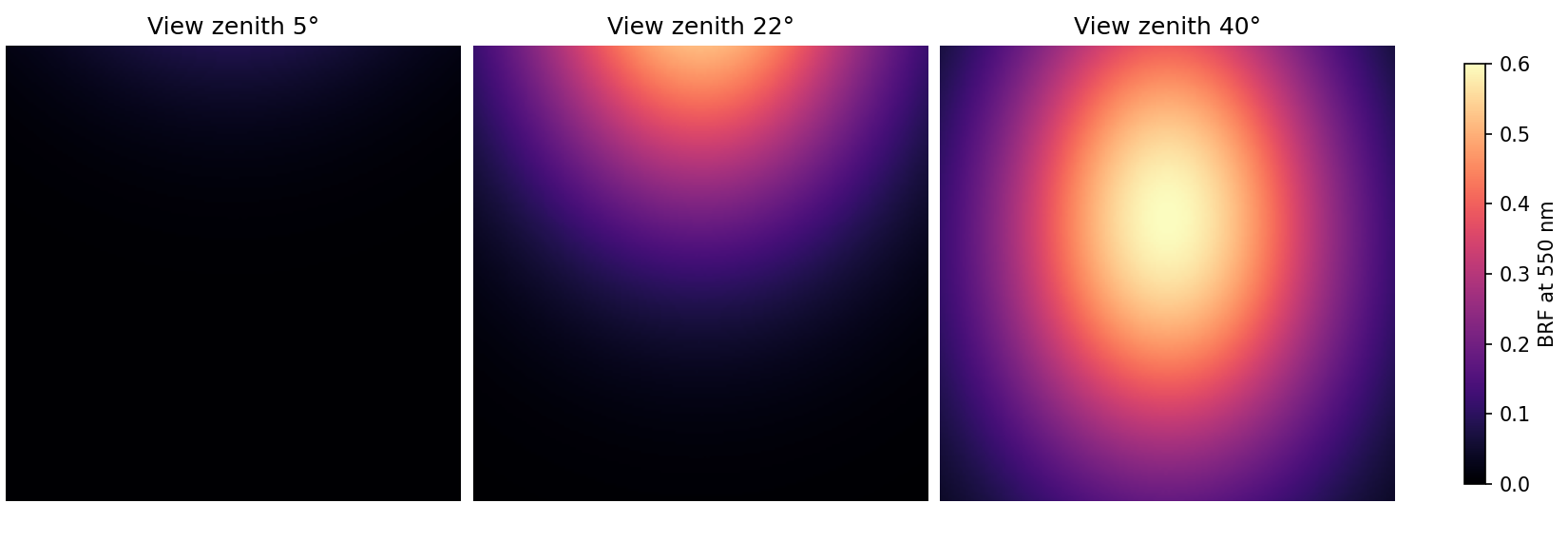
The Sun stays at a zenith angle of 40° and the wind speed is 3 m/s. The sensor observes the same water surface from the side opposite the Sun at central view zenith angles of 5°, 22° and 40°. All panels share a 550 nm BRF scale as the specular reflection moves into the centre.