Appendix A6 - Scene scale and geometric accuracy
Do intersections and images remain accurate when rays travel farther or triangles become larger? This case uses one inclined plane and a narrow occluding board, varying distance, plane size and view angle separately. Each input is compared with and without automatic triangle subdivision.
Scene and inputs
Choose a case, backend and mesh, then drag to rotate, or open the viewer separately. The default view clips the plane to a central 4 m × 2 m window and shows short ray segments. Select Full scene for the complete square and sensor positions. Orange points are simulated intersections; black crosses are analytic.
With horizontal coordinates measured from its centre, the plane satisfies \(z=2+sx\), with \(s=1/32\). The narrow board is parallel, 0.25 m above it, 0.5 m wide and 6 m long. Both are opaque Lambertian surfaces, with reflectances 0.4 and 0.1.
| Condition | Setting |
|---|---|
| Illumination | Vertical parallel sunlight at 550 nm; normal irradiance 1 W m⁻² nm⁻¹ |
| Environment | No atmosphere or sky illumination; open boundaries |
| Radiation component | Direct solar radiance after one surface reflection |
| Square side | 20 m, 1 km, 10 km |
| Distance to the plane centre | 10 m, 1 km, 10 km |
| Viewing direction | From the east; zenith angles 0°, 30°, 75° |
| Radiance image | 64 × 8 pixels over 4 m × 2 m on the horizontal reference plane at Z = 2 m |
| Sampling | 64, 256 and 1024 samples per pixel, adopting 1024 |
| Intersections | Seven zero-divergence rays, including both sides of the board edges |
Seven inputs change one factor at a time:
| Case | Square side | Distance | View zenith |
|---|---|---|---|
| Baseline | 20 m | 10 m | 30° |
| Long range 1 | 20 m | 1 km | 30° |
| Long range 2 | 20 m | 10 km | 30° |
| Large triangles 1 | 1 km | 10 m | 30° |
| Large triangles 2 | 10 km | 10 m | 30° |
| Nadir | 20 m | 10 m | 0° |
| Grazing | 20 m | 1 km | 75° |
The original plane and board each contain two triangles. Calling scene.subdivide_large_primitives(max_area=S*S/256) for a square of side S divides the plane into 512 triangles while preserving its shape, reflectance and observation conditions. Actual triangle counts are checked: the refined complete scene contains 514 triangles.
Independent analytic reference
Intersections and range
For a plane \(\mathbf n\cdot\mathbf p=b\), a ray from o along unit direction d has
Intersect both surfaces, retain intersections inside their finite boundaries, and select the nearest positive range. This directly checks misses, occlusion, point position and range. The perpendicular distance from each simulated point to the nearest surface plane is checked separately.
Radiance and occlusion boundaries
Under vertical sunlight, both surfaces have incidence cosine \(1/\sqrt{1+s^2}\). Their sunlit radiance is
The board, its cast shadow and the sunlit plane therefore have three known radiances. For viewing zenith θ, board width w and height gap h, let \(a=1-s\tan\theta\). The shadow and visible-board intervals on the image reference plane are
Where they overlap, the upper board is visible. Integrating each interval's overlap with a pixel gives its exact average radiance, including boundary pixels.
Results
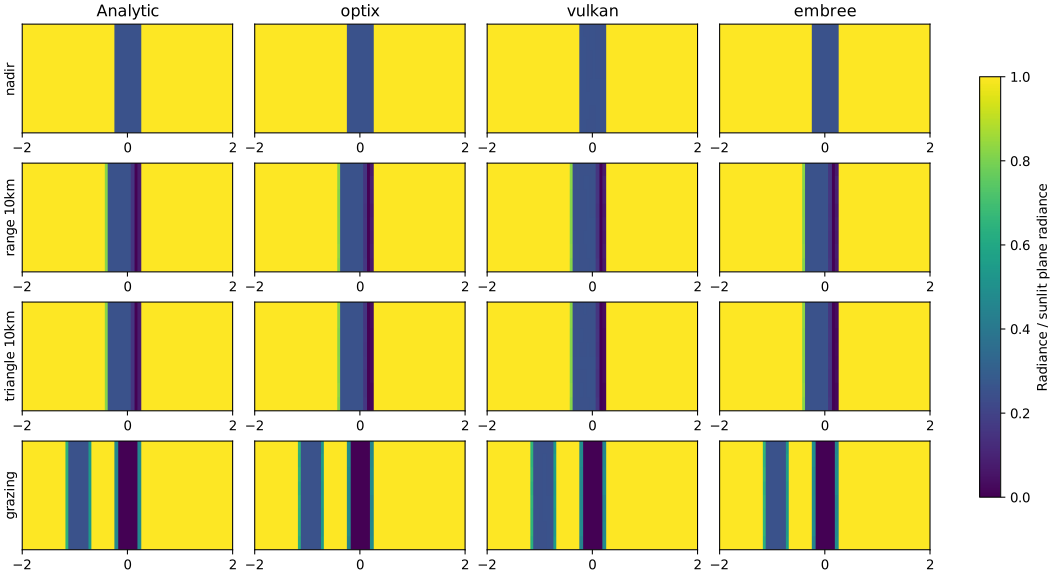
All columns share one colour scale. At nadir, the board hides its shadow; oblique views show both.
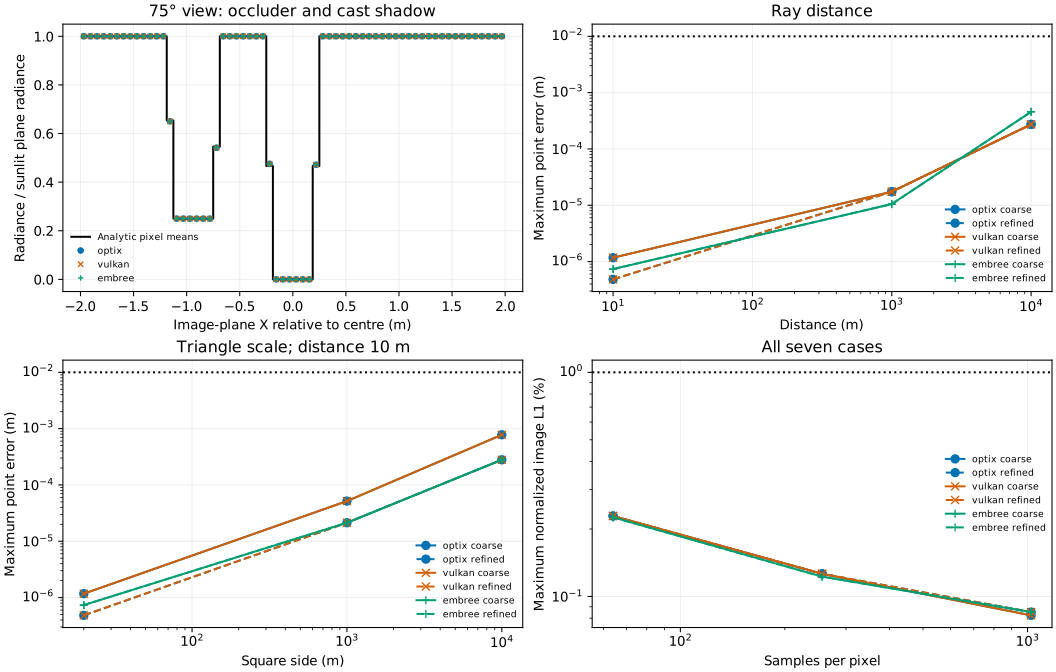
Solid lines denote coarse meshes; dashed lines denote refined meshes. Distance and triangle size are varied separately.
| Metric | Threshold |
|---|---|
| Maximum absolute point-position and range error | Each ≤ 0.01 m |
| Maximum perpendicular distance to the nearest surface plane | ≤ 0.002 m |
| Mean absolute pixel error / sunlit plane radiance | ≤ 1% |
| Maximum relative radiance error in fully sunlit pixels | ≤ 0.1% |
| Difference between coarse and refined column-mean images | ≤ 0.5% |
| Column-mean image change between the final two sampling levels | ≤ 0.5% |
The last two metrics are normalized by sunlit plane radiance. Point positions and ranges come directly from zero-divergence point clouds, without waveform range quantization.
| Backend | Maximum point error / mm | Maximum plane residual / mm | Maximum range error / mm | Mean image error | Result |
|---|---|---|---|---|---|
| optix | 0.7779 | 0.0075 | 0.2509 | 0.0852% | Pass |
| vulkan | 0.7779 | 0.0075 | 0.2509 | 0.0852% | Pass |
| embree | 0.4561 | 0.0005 | 0.2402 | 0.0852% | Pass |
All 42 backend/mesh combinations pass. Both meshes meet the thresholds within the tested distances, sizes and angles. Subdivision further reduces some intersection errors.
Downloads and reproduction
- Inputs and sampling plan
- 20 m plane, 1 km plane, 10 km plane, narrow board
- Result data
- Reproduction script
Keep the relative paths of the script and data/geometry-scale/. With LESS, NumPy and Matplotlib installed, run: