A11 Sunlit and shaded components
Two overlapping leaves at different heights create both view occlusion and shadows. Images resolve sunlit soil, sunlit foliage, shaded soil and shaded foliage against exact geometric areas.
Scene and inputs
The scene is 6 m × 6 m with ground at zero height. The upper leaf spans \(x\in[2.5,4.5]\), \(y\in[1,5]\) at 2 m. The lower leaf spans \(x\in[1,4]\), \(y\in[1.5,4.5]\) at 1 m. Soil and leaf reflectances are 0.2 and 0.3. Classification depends on visible geometry and direct-sun visibility.
| Condition | View zenith | Solar zenith | Directions and boundaries |
|---|---|---|---|
| 1 | 0° | 0° | Finite scene |
| 2 | 0° | 45° | Finite scene |
| 3 | 35° | 45° | Same view/sun azimuth; finite scene |
| 4 | 35° | 45° | Opposite view/sun azimuth; finite scene |
| 5 | 0° | 60° | Periodic; shadows cross the unit boundary |
Directions lie in the east–west plane. A 16 × 16 image covers the unit.
Exact geometric reference
A leaf at height \(z\) shifts by \(-z\tan\theta_v\) when projected onto the ground reference plane. A shadow onto a lower surface at \(z_t\) shifts by \(-(z-z_t)\tan\theta_s\). Leaf, shadow and pixel boundaries partition the plane into rectangles with a unique visible surface and illumination state. Their areas add exactly.
For class areas \(A_{p,c}\) in pixel \(p\),
The reported \(A_c\) is projected area on the reference plane. Periodic conditions include neighboring leaves and shadows. The reference uses no ray sampling.
Results and convergence
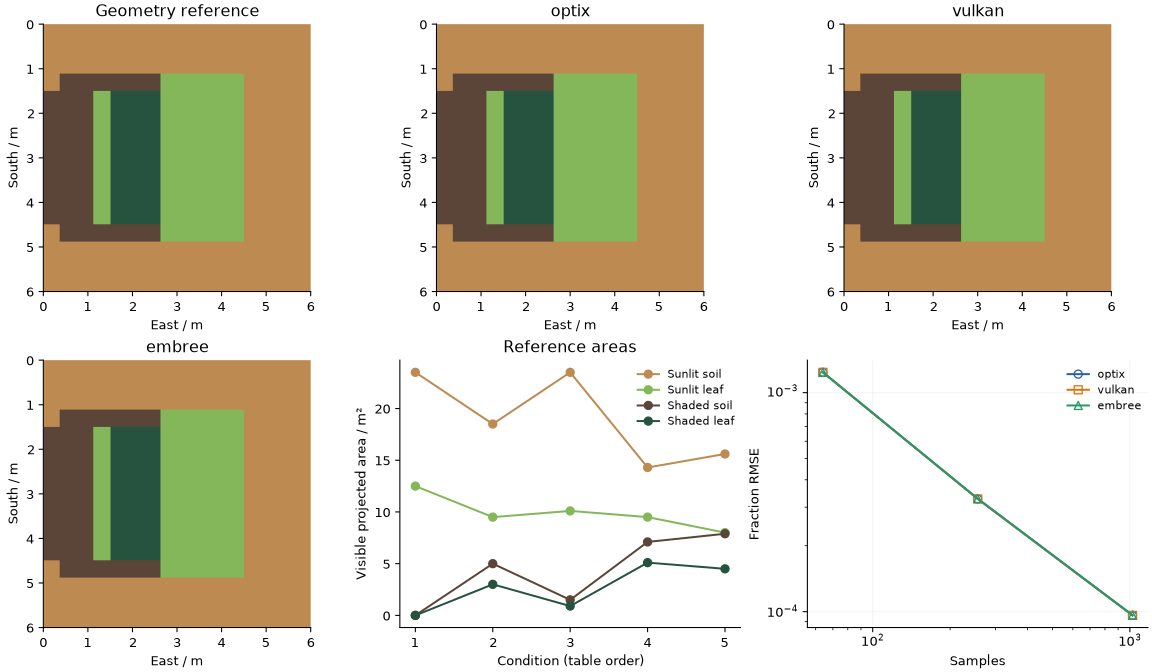
The four class maps show condition 2. The lower-right panels show reference projected areas across all five conditions and sampling convergence.
| Backend | Maximum area error / m² | Maximum fraction RMSE | Fraction-sum error | Result |
|---|---|---|---|---|
| optix | 0.000459 | 0.000114 | 0 | Pass |
| vulkan | 0.000459 | 0.000114 | 0 | Pass |
| embree | 0.000459 | 0.000114 | 0 | Pass |
All 15 groups pass. The class-area limit is 0.01 m²; fraction RMSE and maximum pixel error limits are 0.003 and 0.02. The sum of four fractions must be within 10⁻⁶ of one. Dominant labels must be correct wherever the two largest reference fractions differ by more than 0.05.
Sampling uses 64, 256 and 1024 samples per pixel, with seeds 17, 29 and 43 at each level. The largest class-area change between the final two budgets is 0.001145 m², below 0.01 m². All backends have zero dominant-label errors.
Reproduce
Download the inputs, upper leaf, lower leaf, simulation script, helper, and independent reference. Preserve the scripts/ and data/four-component/ paths. With LESS, NumPy and Matplotlib installed, run:
The complete results provide pixel fractions, classification checks, areas and sampling metrics.