A13 Point irradiance
A point irradiance sensor integrates incident radiance with a cosine response. Uniform sky, Lambertian ground, direct sun and a black screen test angular response, finite field of view, tilt and occlusion separately.
Conditions and analytic references
Ground reflectance is 0.3 and the sensor is 2 m above ground. Uniform sky radiance is \(L=1/\pi\) W m⁻² sr⁻¹ nm⁻¹, giving horizontal irradiance 1 W m⁻² nm⁻¹. Unoccluded conditions use periodic ground.
| Condition | Sensor tilt | Full FOV | Reference irradiance / W m⁻² nm⁻¹ |
|---|---|---|---|
| 1 Uniform sky | 0° | 180° | 1 |
| 2 Narrow sky cone | 0° | 60° | 0.25 |
| 3 Wide sky cone | 0° | 120° | 0.75 |
| 4 Tilted hemisphere | 60° | 180° | 0.825 |
| 5 Tilted narrow cone | 30° | 60° | 0.25 |
| 6 Ground-facing | 180° | 180° | 0.3 |
| 7 Occluded sky | 0° | 180° | 0.445873576 |
| 8 Facing the sun | 30° | 120° | 1 |
| 9 Sun outside FOV | 0° | 30° | 0 |
| 10 Screen blocks sun | 0° | 120° | 0 |
| 11 Sun inside FOV | 0° | 120° | 0.866025404 |
Direct-sun cases use solar zenith 30°, normal irradiance 1 W m⁻² nm⁻¹ and no sky scattering. The screen is a horizontal black 2 m × 2 m square centered 1 m above the sensor. Screen cases use finite 1000 m × 1000 m ground; their upward views contain no ground radiance.
For a full hemisphere tilted by \(\beta\), sky and ground contribute
A cone of half-angle \(\alpha\) entirely within uniform sky receives \(E=\pi L\sin^2\alpha\). Direct sun within the FOV contributes \(E=E_\perp\cos\gamma\), where \(\gamma\) is its angle from the sensor normal. An excluded or blocked sun contributes zero.
For screen half-widths \(a,b\) at distance \(h\), the obscured sky fraction is the differential rectangle view factor:
Results and convergence
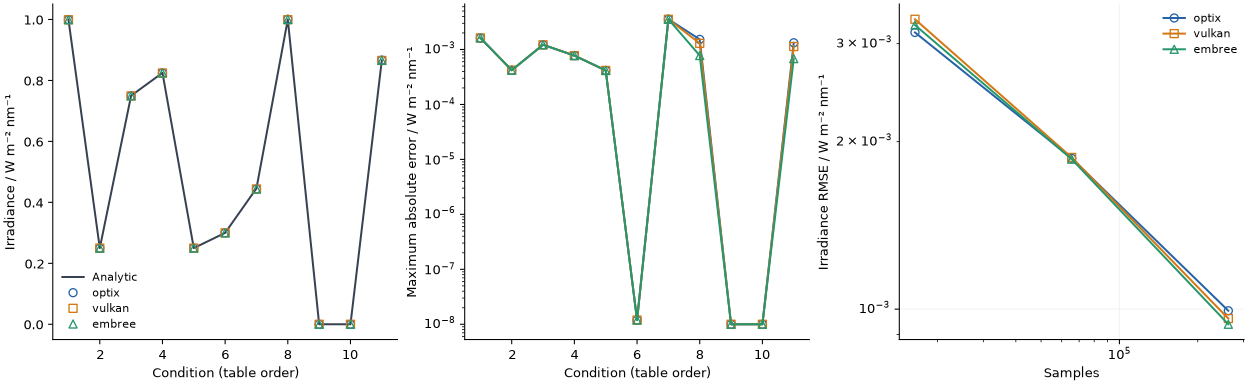
| Backend | Maximum absolute error / W m⁻² nm⁻¹ | Maximum final-budget change / W m⁻² nm⁻¹ | Result |
|---|---|---|---|
| optix | 0.003552 | 0.000796 | Pass |
| vulkan | 0.003552 | 0.000796 | Pass |
| embree | 0.003552 | 0.000796 | Pass |
Each condition uses 16384, 65536 and 262144 directional samples with independent seeds 17, 29 and 43. Errors are the maximum over final-budget seeds. Nonzero cases have absolute error, seed standard deviation and final-budget change limits of 0.01 W m⁻² nm⁻¹. Zero cases use 10⁻⁷. Every replicate must also agree with the analytic value within five reported standard errors plus 10⁻⁵.
Reproduce
Download the inputs, screen, simulation script, helper, and independent formulas. Preserve the scripts/ and data/point-irradiance/ paths. With LESS, NumPy and Matplotlib installed, run:
The complete results include analytic values, means, standard errors and sampling metrics.