Appendix A4 - Thermal radiation cavity
A warm ground and a semitransparent sheet exchange thermal radiation through emission, reflection and absorption. Sky radiation can also pass through the sheet into the cavity. This case compares the resulting radiances with an analytic solution and checks equilibrium when the ground, sheet and sky share one temperature.
Scene
Drag to rotate, or open the scene preview.
The horizontal cell is 2 m × 2 m. The ground is at Z = 0 and the sheet at Z = 1 m. Horizontal periodic boundaries, with up to 10000 crossings, represent infinite parallel planes. There is no solar irradiance or atmospheric attenuation. The sky supplies isotropic blackbody radiation at a prescribed temperature. Both sheet faces have the same properties, with diffuse reflection and transmission.
| Wavelength / µm | Ground emissivity εg | Sheet emissivity εs | Sheet transmittance τ | Sheet reflectance ρs |
|---|---|---|---|---|
| 4 | 0.6 | 0.8 | 0.1 | 0.1 |
| 8 | 0.4 | 0.3 | 0.2 | 0.5 |
| 10 | 0.5 | 0.4 | 0.35 | 0.25 |
| 12 | 0.7 | 0.6 | 0.2 | 0.2 |
| 14 | 0.8 | 0.9 | 0.05 | 0.05 |
The ground is opaque, with ρg = 1 − εg. The sheet satisfies εs + ρs + τ = 1. Two temperature settings are used:
- Unequal temperatures: ground 320 K, sheet 290 K and sky 270 K.
- Isothermal equilibrium: ground, sheet and sky all at 300 K.
We observe upward radiance U inside the cavity, downward radiance D inside it, and upward radiance O above the sheet. Each is measured along the vertical and 60° from the vertical. Interior sensors are at Z = 0.5 m; the exterior sensor is at Z = 1.5 m. Each image has 16 × 16 pixels and an 8° field of view. A downward-looking sensor receives upward radiation; an upward-looking sensor receives downward radiation.
Analytic solution
Planck's law gives blackbody spectral radiance at temperature T:
Using wavelength in metres gives radiance per metre of wavelength. Multiplying by \(10^{-9}\) converts it to the LESS unit W m⁻² sr⁻¹ nm⁻¹. Here h, c and k are the Planck constant, speed of light and Boltzmann constant. The blackbody-plane control uses 280, 300 and 320 K and compares both radiance and recovered brightness temperature with this formula.
Write \(B_g=B_\lambda(T_g)\), \(B_s=B_\lambda(T_s)\) and \(L_{sky}=B_\lambda(T_{sky})\). The view factor between the planes is one, so
Solving gives
Substitution gives D and O. The denominator sums infinitely many thermal reflections; each wavelength is solved independently. At a common temperature, ε + ρ + τ = 1 gives U = D = O = Bλ(T): the equilibrium radiation field is blackbody radiation even though the surfaces are not black. Radiance from these diffuse infinite planes is independent of viewing angle, providing a reference for all six views.
Simulation results
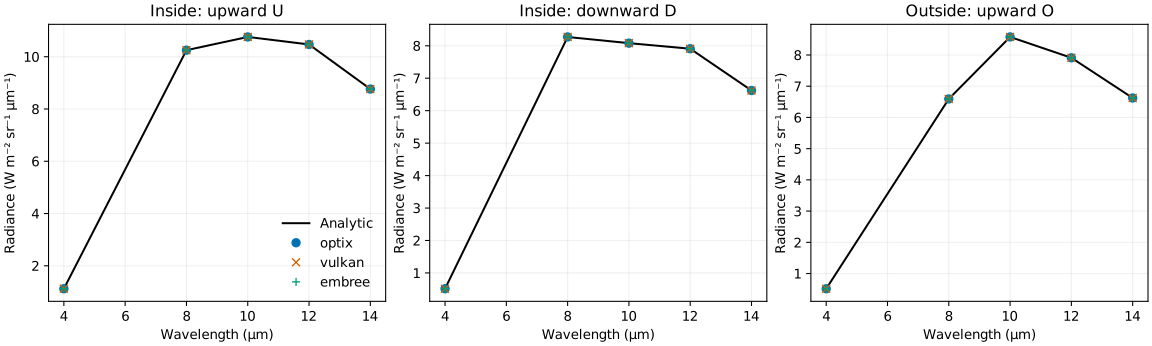
Lines show analytic radiance; symbols show vertical-view results from the three backends. Plots use radiance per µm for readability; downloaded data use radiance per nm.
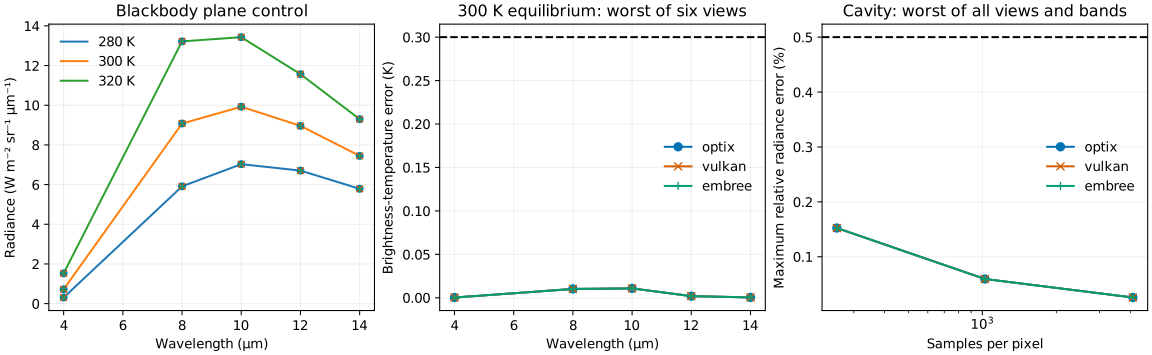
The sampling plan is 256, 1024 and 4096 samples per pixel, with 4096 adopted for the final results. Blackbody controls and all cavity views use the same spectral bands and sampling plan.
Thermal imaging allows up to 16 surface interactions. Here the round-trip ratio ρgρs is at most 0.3, retaining at least seven complete round trips. Multiplying the largest blackbody radiance at each wavelength by (ρgρs)⁷ and normalizing by the smallest analytic radiance gives a conservative truncation bound of 0.044%.
| Metric | Threshold |
|---|---|
| Maximum relative spectral-radiance error | ≤ 0.5% |
| Maximum brightness-temperature difference from the analytic radiance | ≤ 0.3 K |
| Change between the last two budgets, normalized by analytic radiance | ≤ 0.3% |
| Backend | Blackbody radiance error | Cavity radiance error | Cavity BT error / K | Last-budget change | Result |
|---|---|---|---|---|---|
| optix | 0.000004% | 0.0258% | 0.0116 | 0.0477% | Pass |
| vulkan | 0.000017% | 0.0259% | 0.0117 | 0.0478% | Pass |
| embree | 0.000004% | 0.0258% | 0.0116 | 0.0478% | Pass |
All three backends pass. At 300 K equilibrium, the largest brightness-temperature error across six views is 0.0108 K.
Download and reproduce
Keep the relative paths of the script and data/thermal-cavity/, and run:
Use --plot-only results/thermal-cavity/results.json to regenerate plots from existing results; this requires matplotlib.